
🇬🇧 English
🇫🇷 Français
🇩🇪 Deutsch
🇪🇸 Español
🇮🇹 Italiano
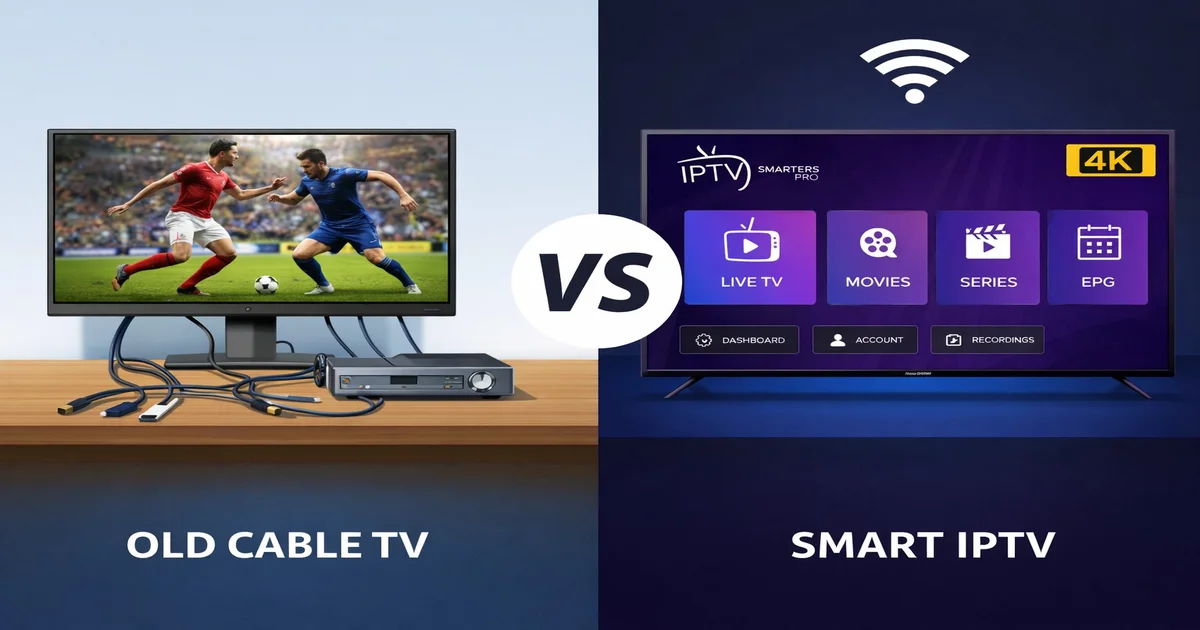
The television landscape has undergone a radical transformation over the past two decades. From bulky cathode-ray tubes and limited broadcast schedules to on-demand 4K streams on any device, the way we consume video content has changed beyond recognition. In 2026, the biggest decision facing cord-cutters and entertainment enthusiasts alike is whether to stick with traditional cable TV or make the leap to IPTV. This comprehensive comparison examines every angle — cost, channel selection, picture quality, flexibility, reliability, and more — so you can make an informed choice.
Television has moved through four distinct eras. In the beginning, households relied on rooftop antennas to pick up a handful of over-the-air broadcast channels. Picture quality was modest, channel choice was severely limited, and reception depended entirely on geography and weather conditions.
The cable revolution of the 1980s and 1990s changed everything — for a while. Coaxial cables brought dozens, then hundreds, of channels into homes, along with premium offerings like HBO and ESPN. But cable came with long-term contracts, expensive hardware rentals, and steadily rising prices that often outpaced inflation.
Satellite TV (DirecTV, Dish Network) offered an alternative with even more channels, but it still required proprietary equipment, suffered during storms, and locked viewers into rigid packages. The real game-changer arrived with broadband internet. Streaming services like Netflix proved that high-quality video could be delivered over IP networks, and IPTV took that concept further by offering live television, video on demand, and catch-up services — all through the internet.
Today, in 2026, IPTV represents the cutting edge of television delivery. It combines the live-channel experience of cable with the flexibility and affordability of streaming, making it the clear successor to every previous generation of TV technology.
IPTV — Internet Protocol Television — delivers live TV channels and on-demand video content over a broadband internet connection instead of through a cable, satellite dish, or antenna. When you tune into an IPTV channel, video data is sent as IP packets from the provider's servers to your device, decoded in real time, and displayed on your screen.
There are two common delivery methods. The first is M3U playlists, which are text files containing URLs for each channel stream. You load the M3U file into a compatible player such as VLC, TiviMate, or IPTV Smarters, and the app connects directly to each stream. The second method uses Xtream Codes API, where your IPTV provider gives you a server URL, username, and password. Your app connects to the API, which dynamically generates your channel list, EPG (Electronic Program Guide), and VOD library.
Both methods support a wide range of devices including Smart TVs (Samsung, LG), Android TV boxes, Amazon Fire TV Stick, Apple TV, smartphones, tablets, and computers. The only requirement is a stable internet connection — typically 15 Mbps for HD and 25 Mbps or more for 4K Ultra HD streams.
Because IPTV is software-based rather than hardware-dependent, it can be updated, improved, and expanded without requiring technicians to visit your home or install new equipment. Providers can add thousands of new channels overnight, implement anti-freeze technology for smoother playback, and introduce features like multi-screen viewing and cloud DVR — all through server-side updates.
Cable TV delivers television programming through a network of coaxial cables (and, increasingly, fibre-optic lines) that run from regional head-ends to individual homes. A set-top box decodes the signal and outputs it to your television. Cable operators typically offer tiered packages — a basic tier with local channels, a standard tier adding popular networks, and premium tiers unlocking movie and sports channels.
While cable infrastructure is mature and widespread, it has inherent limitations. The coaxial last mile constrains bandwidth, which means offering thousands of simultaneous HD or 4K channels is physically challenging. Equipment rental fees (often 10-15 euros per month per box) add up quickly, especially in multi-TV households. And because cable networks are regional monopolies or duopolies, competitive pricing is often lacking — consumers in many areas have only one or two providers to choose from.
Contract requirements are another pain point. Most cable providers require 12 to 24-month commitments, with early termination fees that can reach several hundred euros. This lack of flexibility stands in stark contrast to IPTV's month-to-month or even shorter subscription models.
| Feature | IPTV (SmartHD) | Cable TV |
|---|---|---|
| Monthly Price | From €14.99/month | €30 – €100+/month |
| Number of Channels | 30,000+ live channels | 50 – 500 channels |
| 4K / Ultra HD | Included in all plans | Limited; often extra cost |
| Contract Required | No — cancel anytime | 12 – 24 month lock-in |
| Device Portability | Any device, anywhere | Cable box tied to one TV |
| Video on Demand (VOD) | 90,000+ movies & series | Limited on-demand library |
| International Channels | 50+ countries covered | Few international options |
| Installation | Instant (no technician) | Professional install required |
| Equipment | Use your existing devices | Rented set-top box (€10-15/mo) |
The most immediately compelling advantage of IPTV is price. A full-featured IPTV SmartHD subscription starts at just 14.99 euros per month, giving you access to over 30,000 live channels and 90,000+ VOD titles. An equivalent cable package — if one even existed — would cost upward of 80 to 100 euros per month, plus equipment rental and installation fees. Over a year, IPTV can save a household 600 to 1,000 euros without sacrificing content.
Cable providers are limited by bandwidth and licensing deals within their geographic region. IPTV providers like SmartHD aggregate channels from over 50 countries, covering every genre: sports (including premium leagues), news, entertainment, documentaries, kids programming, music, and international channels in dozens of languages. Whether you want to watch the Premier League, Bundesliga, La Liga, or Serie A — it is all available in one subscription.
While cable companies charge premiums for HD upgrades and offer minimal 4K content, IPTV SmartHD includes 4K Ultra HD channels in every plan. With modern H.265/HEVC compression and adaptive bitrate streaming, IPTV delivers stunning picture quality even on moderate internet connections.
IPTV works on virtually any screen: Smart TVs, Android boxes, Fire TV Stick, Apple TV, iPads, iPhones, Android phones, laptops, and desktops. Many plans support simultaneous connections, so different family members can watch different channels on different devices at the same time — no extra hardware needed.
With IPTV SmartHD, you pay month to month. There are no long-term contracts, no cancellation fees, and no hidden charges. If you are not satisfied, simply do not renew. This flexibility is especially valuable for expats, travelers, and anyone who does not want to be tied to a single provider.
For expatriates and multilingual households, IPTV is transformative. Access channels from your home country in your native language — Arabic, Turkish, Portuguese, Hindi, French, German, Spanish, and many more — without purchasing expensive add-on packages that cable companies rarely even offer.
Despite IPTV's many advantages, cable TV still holds certain edges in specific scenarios. Here is an honest look at where cable may be preferable:
IPTV depends entirely on your internet connection. In rural areas or regions with slow, unreliable broadband (under 10 Mbps), cable TV can provide a more consistent viewing experience without buffering or quality drops. However, as fibre-optic and 5G networks expand rapidly in 2026, this gap is narrowing every month.
Cable providers typically include all local broadcast channels as part of their basic package. While IPTV services cover major international and national channels comprehensively, very niche local-access or community channels may not always be available. For viewers who rely heavily on hyper-local programming, cable — or a simple digital antenna — might supplement an IPTV subscription.
Many cable companies offer triple-play bundles combining TV, internet, and phone service at a discounted rate. If you are already paying for cable internet, adding their TV service may seem cost-effective. However, when you compare the TV portion alone to IPTV, the savings with IPTV are still substantial — you just need to evaluate the bundle as a whole.
Let us break down the real-world costs for a typical household in 2026:
| Expense | IPTV SmartHD | Average Cable Provider |
|---|---|---|
| Monthly subscription | €14.99 – €49.99 | €40 – €100 |
| Equipment rental | €0 (use your devices) | €10 – €15/month |
| Installation fee | €0 | €50 – €150 |
| 4K upgrade | €0 (included) | €5 – €15/month |
| Sports package | €0 (included) | €10 – €30/month |
| Annual total (estimated) | €120 – €600 | €780 – €1,800+ |
Even comparing the premium IPTV tier to a mid-range cable package, the savings are significant. And with IPTV SmartHD, you get far more content — over 30,000 channels and 90,000+ VOD titles versus a few hundred channels on cable. Check our current pricing plans for the latest offers.
Switching from cable TV to IPTV is straightforward and can be completed in under 30 minutes. Follow these steps:
IPTV technology itself is completely legal. It is simply a method of delivering television content over the internet. The legality depends on the content provider and the licensing of the channels they offer. IPTV SmartHD operates as a legitimate service delivering premium entertainment to subscribers worldwide.
For smooth HD streaming, a minimum of 15 Mbps is recommended. For 4K Ultra HD content, aim for 25 Mbps or higher. Most modern broadband, fibre, or 5G connections easily meet these requirements. A wired Ethernet connection is ideal for the most stable experience.
Yes. IPTV SmartHD offers plans with multiple simultaneous connections. This means different family members can watch different channels on different devices — a Smart TV, tablet, phone, or laptop — all at the same time, with a single subscription.
Absolutely. One of IPTV's greatest strengths is portability. As long as you have an internet connection, you can watch your channels from anywhere in the world — on holiday, on business trips, or if you relocate. No geographic restrictions apply with IPTV SmartHD.
Free streaming sites are often plagued by ads, malware, unreliable links, and poor video quality. IPTV SmartHD provides ad-free, high-definition streams with 99.9% uptime, a professional EPG, and responsive customer support. The small monthly fee buys reliability, quality, and peace of mind.
The evidence is clear: IPTV outperforms cable TV in virtually every category that matters to modern viewers. It costs less, offers exponentially more content, delivers superior picture quality, works on any device, and frees you from contracts and hardware rentals. Cable TV still has a place in areas with poor internet connectivity, but for the vast majority of households in 2026, IPTV is the smarter, more economical, and more enjoyable choice.
Ready to experience the difference? Browse IPTV SmartHD plans, explore our full channel lineup, or start your free 24-hour trial today. Join millions of viewers who have already made the switch — and discover why they never looked back.
Join millions already watching IPTV SmartHD. 30,000+ channels, 4K, no contract.
Start Your 24h Free Trial